
Barcodes are a critical part of modern business operations, powering everything from retail checkout systems to warehouse inventory tracking and healthcare workflows.
When choosing a barcode scanner, one of the most important decisions is understanding the difference between 1D and 2D barcodes. The type you use directly impacts scanning speed, data capacity, and future scalability.
In this guide, we’ll break down the differences and help you choose the right barcode type for your application.
WHAT ARE BARCODES?
A barcode is a machine-readable format that stores data in a visual pattern of lines or shapes. Scanners decode this information instantly, allowing businesses to track products, assets, and information efficiently.
There are two primary categories:
- 1D (linear) barcodes
- 2D (matrix) barcodes
Each serves different business needs and requires different scanning technology.
1D BARCODES (LINEAR)
D barcodes are the traditional barcode format made up of vertical lines and spaces. They store data horizontally and are widely used across many industries.
Common examples include:
- UPC (Universal Product Code)
- EAN (European Article Number)
- Code 39
- Code 128
Common use cases:
- Retail point-of-sale systems
- Inventory tracking
- Shipping and logistics
- Asset labeling
Advantages:
- Simple and cost-effective
- Fast scanning in high-volume environments
- Widely supported across all industries
Limitations:
- Limited data storage
- Requires line-of-sight alignment
- Cannot store complex information
2D BARCODES (MATRIX)
2D barcodes store data both horizontally and vertically, allowing them to hold significantly more information in a compact space.
Common examples include:
- QR Codes
- Data Matrix
- PDF417
Common use cases:
- Mobile ticketing and marketing
- Healthcare and patient tracking
- Manufacturing traceability
- Logistics and shipping labels
Advantages:
- High data capacity (URLs, images, serial data)
- Can be scanned from any angle
- More durable and error-resistant
- Supports mobile integration
Limitations:
- Requires image-based (2D) scanners
- Slightly higher initial cost
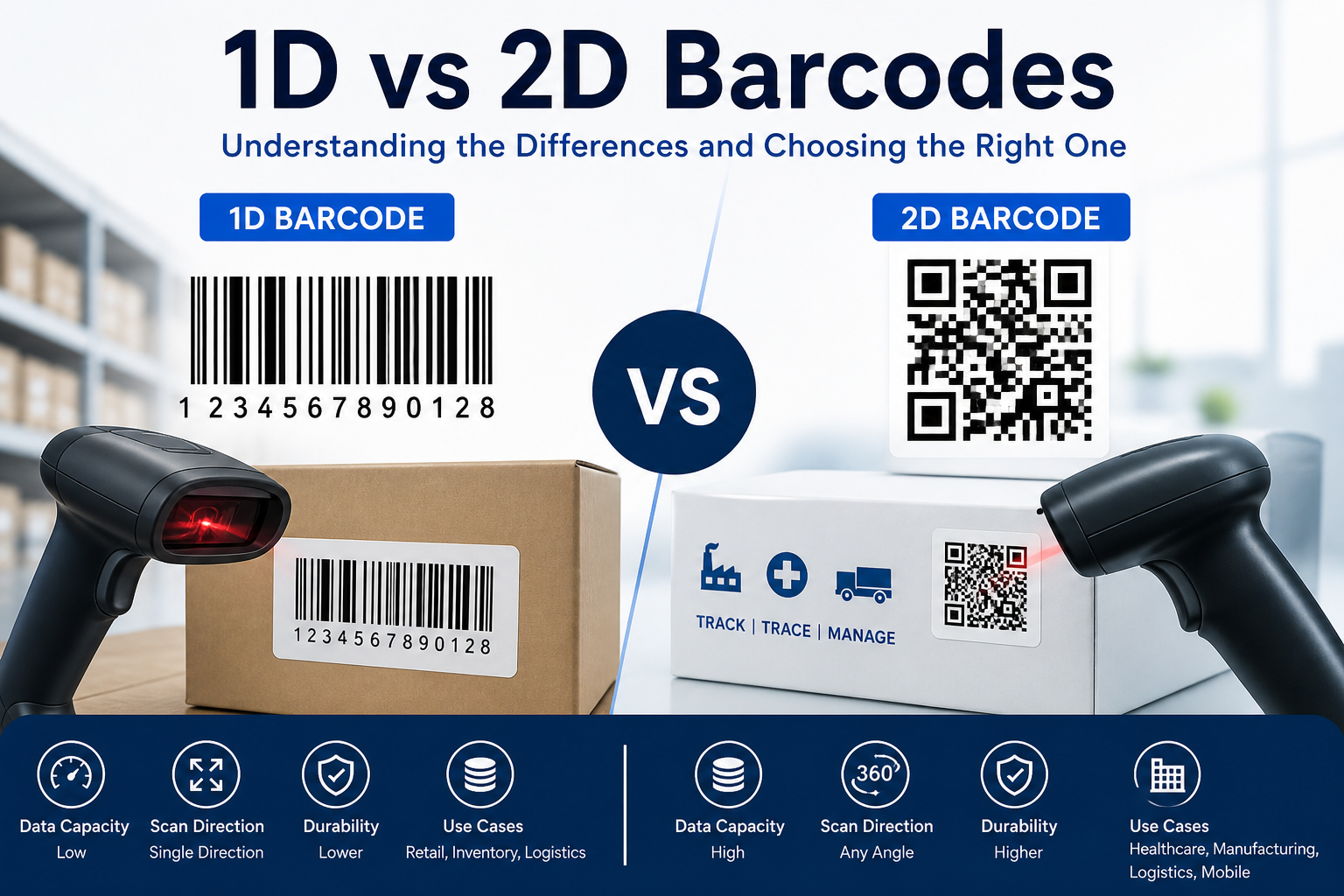
1D VS 2D COMPARISON
Here’s a simple comparison of 1D and 2D barcodes:
| Feature | 1D Barcodes | 2D Barcodes |
|---|---|---|
| Data Capacity | Low | High |
| Shape | Linear (bars) | Square or matrix |
| Scan Direction | Single direction | Any angle |
| Error Tolerance | Low | High |
| Common Use | Retail, logistics | Healthcare, manufacturing, mobile |
Key takeaway:
2D barcodes offer greater flexibility and future-proofing, while 1D barcodes remain ideal for simple, high-speed retail applications.
Understanding barcode types is essential when selecting the right scanning technology for your business. While 1D barcodes remain widely used, 2D barcodes are quickly becoming the standard due to their flexibility and data capacity.
Choosing the right solution today helps ensure efficiency, accuracy, and scalability in the future.
Frequently Asked Questions
What is the difference between 1D and 2D barcodes?
1D barcodes store data in horizontal lines, while 2D barcodes store data both horizontally and vertically, allowing more information in less space.
Do I need a 1D or 2D barcode scanner?
If you only scan traditional barcodes, a 1D scanner may work. However, 2D scanners are more flexible and future-proof.
Can 2D scanners read 1D barcodes?
Yes, most modern 2D scanners can read both types.
Need help choosing the right barcode scanner?
SSE Technologies can help you select the right barcode scanner based on your application, environment, and workflow needs.
Contact us today, and we’ll guide you to the perfect solution for your business needs!